
Unable to complete your ITR filing?
What is an Income-tax Notice?
An Income-tax notice is an official communication issued by the Income Tax Department to a taxpayer or another person in connection with a tax return, assessment, demand, refund, inquiry, reassessment or other proceeding.
The Department may issue a notice, intimation, letter, summons or order for reasons such as:
- a defect or inconsistency in the Income Tax Return (ITR)
- proposed adjustments while processing the return
- requirement of additional information or supporting documents
- selection of the return for scrutiny
- information suggesting that income has escaped assessment
- an outstanding tax demand
- proposed adjustment of a refund against an outstanding demand or
- an inquiry or investigation under the Income-tax law
Receiving an Income-tax notice does not automatically mean that the taxpayer has committed a violation or concealed income. The nature and seriousness of the communication depend on the provision under which it has been issued.
The taxpayer should carefully read the complete communication, identify the relevant year and provision, check the response deadline and take appropriate action within the time allowed.
Which Income-tax Act applies to a notice issued in 2026?
The Income-tax Act, 2025 came into force from 1 April 2026 and replaced the Income-tax Act, 1961. However, proceedings relating to earlier years may continue to be governed by the Income-tax Act, 1961 under the applicable repeal, savings and transitional provisions.
| Period to which the matter relates | Generally applicable legislation |
|---|---|
| FY 2025-26 / AY 2026-27 and earlier years | Income-tax Act, 1961, subject to applicable transitional and saving provisions |
| Tax Year 2026-27, i.e. income from 1 April 2026 onwards | Income-tax Act, 2025 |
For example, an Income Tax Return relating to income earned during FY 2025-26 continues to relate to AY 2026-27 under the Income-tax Act, 1961, even though the return may be filed after 1 April 2026.
Therefore, taxpayers may continue to receive communications referring to familiar provisions such as Sections 139(9), 142(1), 143(2), 148 or 156 for earlier years, while proceedings relating to later tax years may refer to corresponding provisions under the Income-tax Act, 2025.
How to Check Income-tax Notices on the e-Filing Portal?
The e-Proceedings facility on the Income Tax e-Filing portal allows registered taxpayers to view and respond to notices, intimations and letters issued by the Assessing Officer, CPC or another Income-tax Authority.
Step 1: Login to the Income Tax e-Filing Portal
Visit the official Income Tax e-Filing portal and log in using your User ID and password.

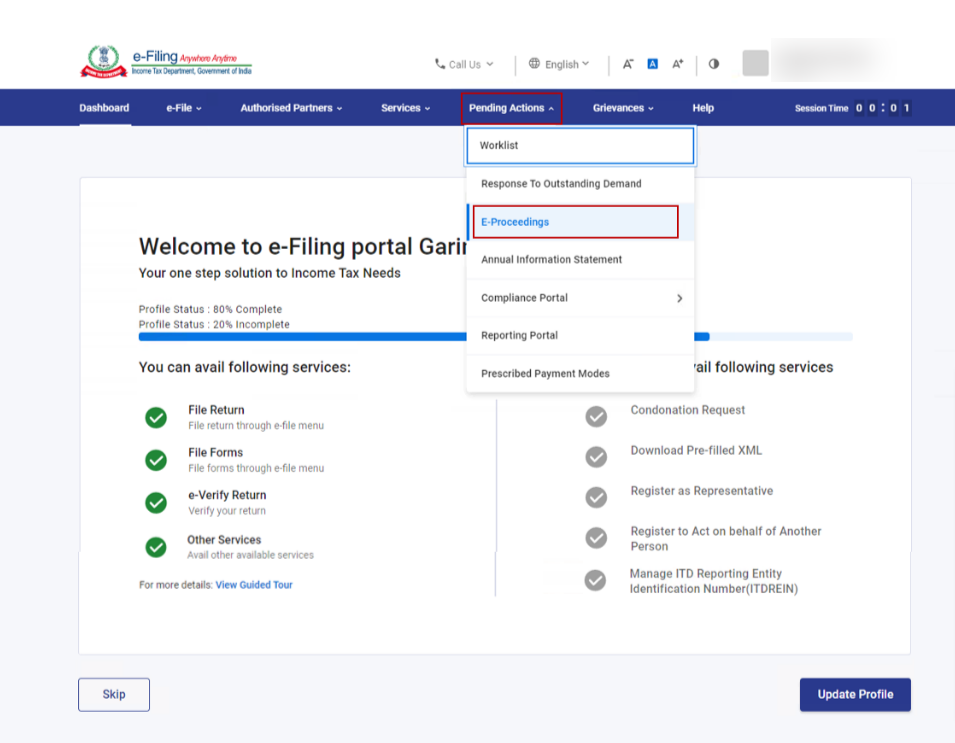
Step 2: Open e-Proceedings
After logging in, navigate to:
Dashboard > Pending Actions > e-Proceedings
The e-Proceedings facility is used for various communications and proceedings requiring action from the taxpayer.
Step 3: View the Notice or Proceeding
On the e-Proceedings page, open the relevant proceeding under Self or the corresponding action tab displayed on the portal.
You can then review details such as:
- section or provision under which the communication has been issued
- Assessment Year or Tax Year
- date of issue
- Document Identification Number (DIN), where applicable
- response due date
- reason or issue raised by the Department and
- documents or information required
Note: Not every tax-related action necessarily appears only under e-Proceedings. For example, outstanding demands and certain compliance matters may have separate services such as Respond to Outstanding Demand or the Compliance Portal.
How to Authenticate an Income-tax Notice or Order?
If you receive a notice, order, summons, letter or other communication and want to confirm whether it is genuine, the Income Tax Department provides an Authenticate Notice / Order issued by ITD service on the e-Filing portal.
You can generally use this facility without logging in.
- Visit the Income Tax e-Filing portal .
- Under Quick Links, select Authenticate Notice / Order issued by ITD.
- Enter the information requested by the portal. Authentication may be available using document details or the Document Identification Number (DIN).
- Complete the OTP verification, where required.
- The portal will display whether a corresponding communication has been issued by the Income Tax Department.
Income Tax Department communications covered by the DIN framework generally carry a computer-generated Document Identification Number. If you have doubts about a communication, authenticate it through the official e-Filing portal before taking further action.
Common Types of Income-tax Notices and Communications
During the transition to the Income-tax Act, 2025, taxpayers should first identify the year and legislation mentioned in the communication.
| Type of communication | Income-tax Act, 1961 | Income-tax Act, 2025 | What does it mean? |
|---|---|---|---|
| Defective Return | Section 139(9) | Section 263(7) | Issued where a return is considered defective. The taxpayer is given an opportunity to rectify the defect within the period specified under the law or allowed by the authority. |
| Processing of Return / Intimation | Section 143(1) | Section 270(1) | Issued after processing of the return and may show adjustments, income, tax payable, refund, interest or other amounts. It should not be confused with scrutiny assessment. |
| Inquiry before Assessment | Section 142(1) | Section 268(1) | The Assessing Officer may require the taxpayer to furnish a return, accounts, documents or written information required for assessment. |
| Scrutiny Notice | Section 143(2) | Section 270(8) | Issued where the return is selected for detailed verification to determine, among other things, whether income has been understated, excessive loss has been computed or tax has been underpaid. |
| Calling for Information | Section 133(6) | Section 252 | Income-tax authorities may call for information considered useful or relevant to an inquiry or proceeding. Information may also be sought from other persons in appropriate cases. |
| Summons / Inquiry or Investigation | Section 131 | Section 246 | Certain Income-tax Authorities have powers relating to attendance, examination of persons and production of books, records or documents. |
| Income Escaping Assessment / Reassessment | Section 148 read with Section 148A | Sections 280 and 281 | These provisions apply to reassessment proceedings where the statutory conditions relating to income escaping assessment are satisfied. |
| Notice of Demand | Section 156 | Section 289 | Issued where tax, interest, penalty or another amount becomes payable as a consequence of an assessment, order or other proceeding. |
| Refund Set-off / Withholding | Section 245 | Section 438 | Deals with adjustment or withholding of a refund against amounts remaining payable, subject to the applicable statutory procedure. |
Is a Notice under Section 143(2) Issued Only After Section 142(1)?
No.
A notice under Section 143(2) of the Income-tax Act, 1961 is a scrutiny notice issued where the Department considers detailed verification of the return necessary.
It is not necessary that a notice under Section 142(1) must first have been issued. A Section 143(2) notice also does not by itself mean that the Assessing Officer was dissatisfied with documents previously submitted by the taxpayer.
Under the Income-tax Act, 2025, the corresponding scrutiny provision is contained in Section 270(8).
Important: Section 245 and Section 245A Are Different
Refund adjustment under the Income-tax Act, 1961 is dealt with under Section 245.
Therefore, Section 245A should not be described as a refund-adjustment notice. The earlier reference to Section 245A for refund adjustment has been removed.
How to Respond to an Income-tax Notice?
The appropriate response depends on the provision, issue and year mentioned in the notice. Before submitting your response, follow these steps:
- Read the complete notice: Do not rely only on the email or SMS alert. Download and read the actual communication along with its annexures.
- Check the applicable year and legislation: Determine whether the matter relates to an Assessment Year governed by the Income-tax Act, 1961 or a Tax Year governed by the Income-tax Act, 2025.
- Verify the communication: Authenticate the notice through the official e-Filing portal if there is any doubt regarding its genuineness.
- Check the response deadline: Different notices may have different statutory or specified response periods.
- Understand the issue raised: Compare the notice with the ITR, tax computation, AIS, Form 26AS and other relevant records.
- Prepare a point-wise response: Address each query clearly and attach relevant supporting documents.
- Use the correct portal service: Submit the response through e-Proceedings, Respond to Outstanding Demand, Compliance Portal or another applicable service.
- Save the acknowledgement: Retain the acknowledgement, transaction ID and copies of the response and attachments submitted.
For scrutiny, reassessment, significant tax demands or complex factual issues, professional review may be advisable before submitting a response.
Common Mistakes to Avoid
- Ignoring a notice because no physical copy was received.
- Responding only to an email instead of using the prescribed portal facility.
- Missing the response due date.
- Assuming that every Income-tax communication is a scrutiny notice.
- Treating an intimation under Section 143(1) as the same as a scrutiny notice under Section 143(2).
- Paying an outstanding demand without checking the underlying computation and order.
- Responding for the wrong Assessment Year or Tax Year.
- Using provisions of the Income-tax Act, 1961 for a proceeding governed by the Income-tax Act, 2025, or vice versa.
- Uploading incomplete, inconsistent or unrelated documents.
- Ignoring a proposed adjustment of refund against an outstanding demand.
Need Assistance with an Income-tax Notice?
If you are unsure about the reason for a notice or the appropriate response, professional assistance can help you understand the issue and prepare the required submission.
myITreturn Notice Assistance can help with reviewing the notice, understanding the issue, examining relevant documents and preparing an appropriate response based on the facts of the case.
Know more about Notice Assistance
Conclusion
An Income-tax notice should be addressed carefully, but receiving one does not by itself mean that the taxpayer has committed an offence or concealed income.
The first step is to identify the applicable Act, section, Assessment Year or Tax Year, response deadline and issue raised.
With the Income-tax Act, 2025 in force from 1 April 2026, taxpayers may receive communications under either the Income-tax Act, 1961 or the Income-tax Act, 2025 depending on the period and proceeding involved.
Always read the complete communication, authenticate it where necessary and submit an accurate response within the applicable time limit.
For Assisted Service, please WhatsApp us on +91-9320546101 or raise a support ticket here
Comments
0 comments
Please sign in to leave a comment.